Plumbing work

Central Heating Leak
Detection Banbury

Central Heating Leak Detection Equipment

How to find a leak
in a central heating system

Many people’s first thought after discovering their central
heating system has a leak is to book a boiler service – but be
warned; this alone won’t deal with the problem.

While a Gas-Safe engineer will be able to check your boiler
components, they will not have the time and tools needed to
explore more complex issues throughout the system. Your boiler
could get a clean bill of health – yet you could still have a serious
sleak somewhere in your central heating pipes.

The best and most cost-effective way to deal with your leak is
to use a Trace and Access service from a professional leak
detection company.

If you’re finding that you need to keep adding water to your boiler
to keep the central heating system pressure up, there’s a good chance that you’ve got a leak.

To make sure heat gets to every part of your house, the water in your central heating system is held under pressure. The problem is, if this pressure drops too low, your boiler is designed to switch off – which means no heat and no hot water.

To get to the bottom of the problem, you might need the help of a professional leak detection service – but before we explore how we’d help you tackle your central heating pressure problems; we’ll help you understand why leaks occur and look at a couple of steps you can take to attempt to solve the problem yourself.

CALL NOW ON 0800 731 3843

Why is your central heating pressure dropping?

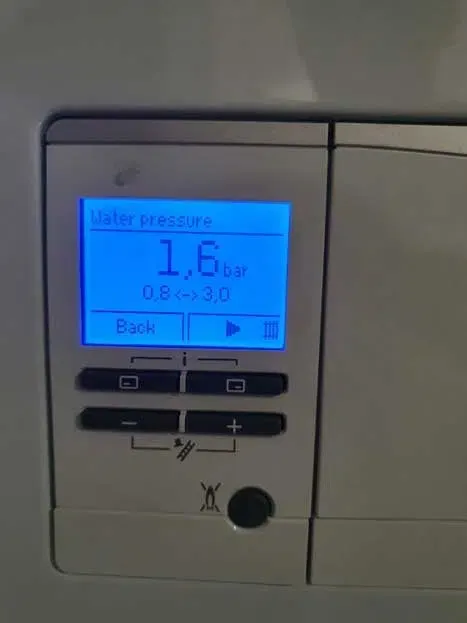
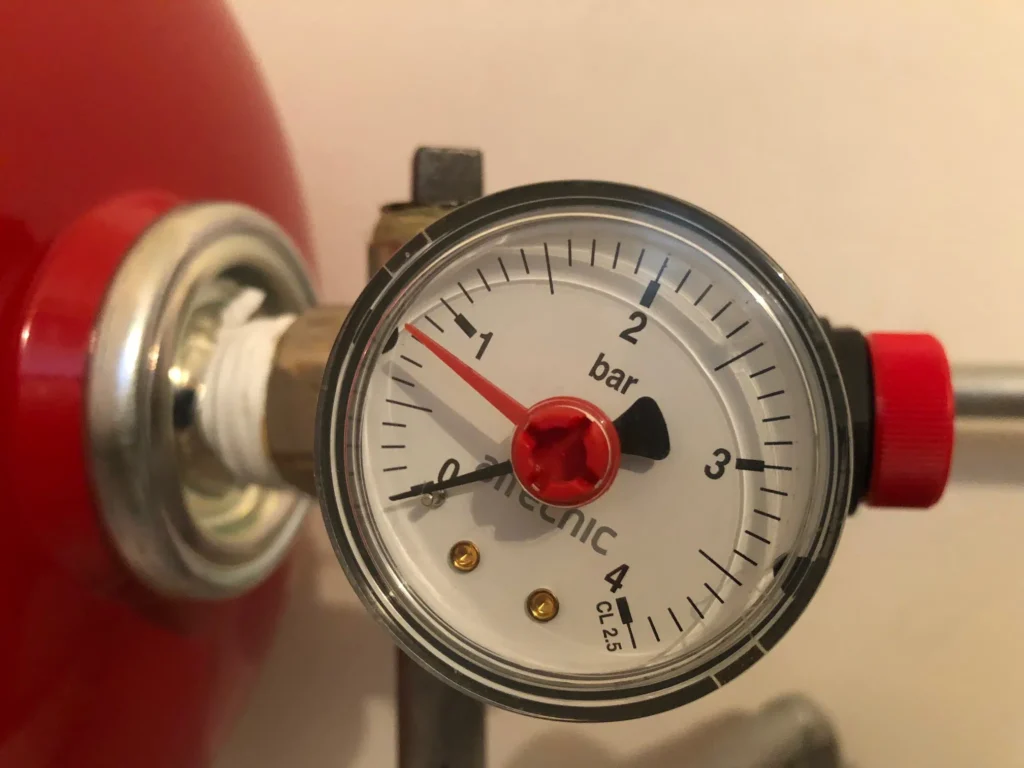
Central heating pressure Gauge Virtually all boilers have a pressure gauge on the front. Most of these are hydraulic dials, although you’ll find some have a digital display. Usually, you’d expect your boiler pressure to be around 1 bar if your heating is off, and around 2 bar when the heating is on and the system is warm.

Although there are a few sensitive components in your boiler that could cause pressure problems, generally, if your pressure reading is lower than this, it’s likely to mean that you’ve either got a leak – or you’ve got air trapped somewhere in the system.

Digital-Boiler-Pressure-Gauge-1
indian-repairman-uniform-installing-outside-unit-air-conditioner

What happens when you’ve got a central heating leak?

It’s easy to consider leaking central heating pipes or your boiler losing pressure just to be an inconvenience – but they’re actually problems that can end up causing a lot of expensive damage if you don’t deal with them quickly.

The trouble is, your central heating system runs all the way through your house; under your floors, through your walls, and often even into your loft space. As a result, water can leak in places that aren’t immediately obvious – and a lot of damage can occur before there are any visible signs.

Even a small, steady drip of water can cause damp in the structure of your home – and unless you act quickly, you might find the bill for putting things right will run into thousands – sometimes even tens of thousands.

CALL NOW ON 0800 731 3843

How to fix a water leaks in a
central heating system

In some cases, low pressure is simply down to air that’s trapped somewhere in the radiators. This is more likely to be the case if you’ve had work done on your central heating system recently – and it’s a fairly easy problem to solve.

central_heating_leak_no_logo

Dealing with trapped air in your system

Air causes a problem in central heating systems because it can be compressed more easily than water. As the pressure in the system goes up, the water compresses the air, and your system pressure drops again.

The only way to solve the problem is to bleed your radiators – to get rid of the air altogether.

Luckily, this is easily done. You’ll need a bleed key – and, if you’re not careful, a towel! Use the bleed key to gently release the radiator vent – and, if you’ve got trapped air, it’ll hiss out – similar to letting air out of a bike or car tyre. Remember, there’s water in there too, so when the hiss stops, get ready to tighten the vent back up – before water comes out.

You should repeat this process with each of your radiators and towel rails.

Increasing pressure with the filling loop

Assuming you’ve managed to get air out of your radiators, you’ll find that the pressure in your boiler might have dropped again. You’ll need to top this up using the ‘filling loop’.

On many boilers, the filling loop is part of the system – but on some, it’s an additional length of hose that you’ll need to secure to the pipework near the boiler. If you’re unsure about any part of the process, you should check your boiler instructions – or check on your boiler manufacturer’s website – as many have helpful videos explaining what to do.

Usually, topping up the system fluid and pressure will require you to:

  • Switch off your boiler and waiting for it to cool down
  • Open the valve on the filling loop (you’ll hear water entering the system)
  • Let the pressure gauge get up to 1.5 bar
  • Close the filling loop valve
  • Restart or switch on your boiler

It’s vital that you only increase the pressure in your boiler if you’ve followed your manufacturer’s instructions and feel absolutely confident doing so. Overfilling a boiler can cause damage (and further leaks) – so be careful.

If you notice your boiler pressure dropping away straight after you’ve followed this procedure, you should get in touch with us as quickly as possib le – as this would indicate a large leak that needs immediate attention.

unvented-boiler
Boiler-pressure-guage-rotated

Don’t damage your boiler by repeatedly ‘topping-up’

If you manage to top-up your boiler and it keeps good pressure after bleeding your radiators, this is great news. That said, if your boiler continues to lose pressure, it’s important you don’t just keep topping it up and ignoring an underlying problem.

The fluid that’s inside your radiators isn’t just water – it’s actually got a number of chemicals mixed into it. This fluid will have been added when your system or boiler was installed – and it’s referred to as an ‘inhibitor’.

Inhibitor fluid is designed to stop nasty build-ups of sludge or corrosion in your heating pipes. It comes in a very concentrated formula – to be diluted by water in your system. However, if it’s diluted too much, it becomes ineffective – and this can lead to increased wear and poor efficiency throughout your system. If you’ve got a leak and you keep topping up with water, you’ll eventually have no inhibitor left.

Because of the damage that can be caused, continually topping up from the filling loop isn’t a good idea. If your system continues to lose pressure, it’s time to take more serious steps.

'

How do we work?

When most people think about getting a company in to find a leak, they expect to have their carpets and floors lifted, holes made in walls, or their driveway dug up – but the reality is very different!

Our Leak Detection Equipment

We use specialist Leak detection equipment to find central heating leaks non-invasively. What’s more, we have no issue working around any kind of flooring, including:

  • Carpeted floors
  • Wooden or laminate flooring
  • Vinyl flooring or tiles
  • Ceramic tiles
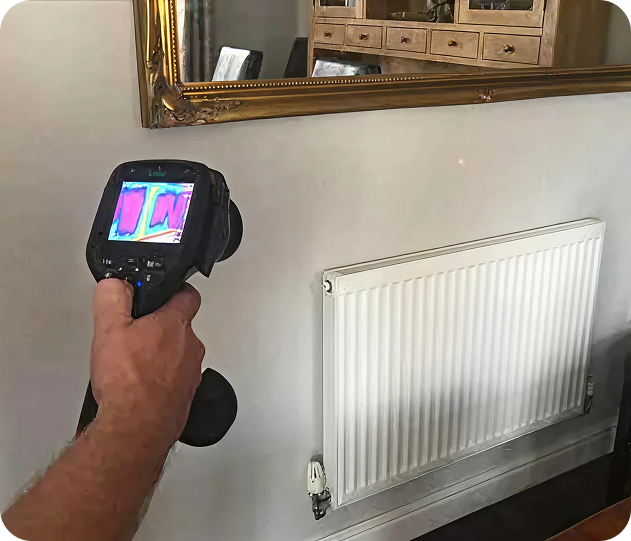
  • Lino flooring We have thermal imaging cameras to look for temperature changes that leaking water will cause; acoustic leak detection equipment to check the integrity of pipework and detect water; and gas tracer systems that can detect even the slightest problem in plumbing connections

Our industry-leading equipment and expertise mean we’re able to trace virtually every leak to within a couple of centimetres too – so any central heating repair work that’s required can be done exactly where it’s needed – with no unnecessary work or mess in your home.

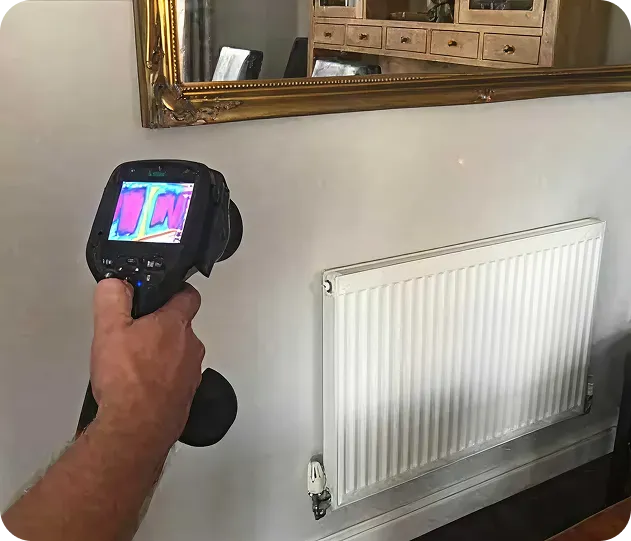
Thermal imaging camera

TRACER GASES

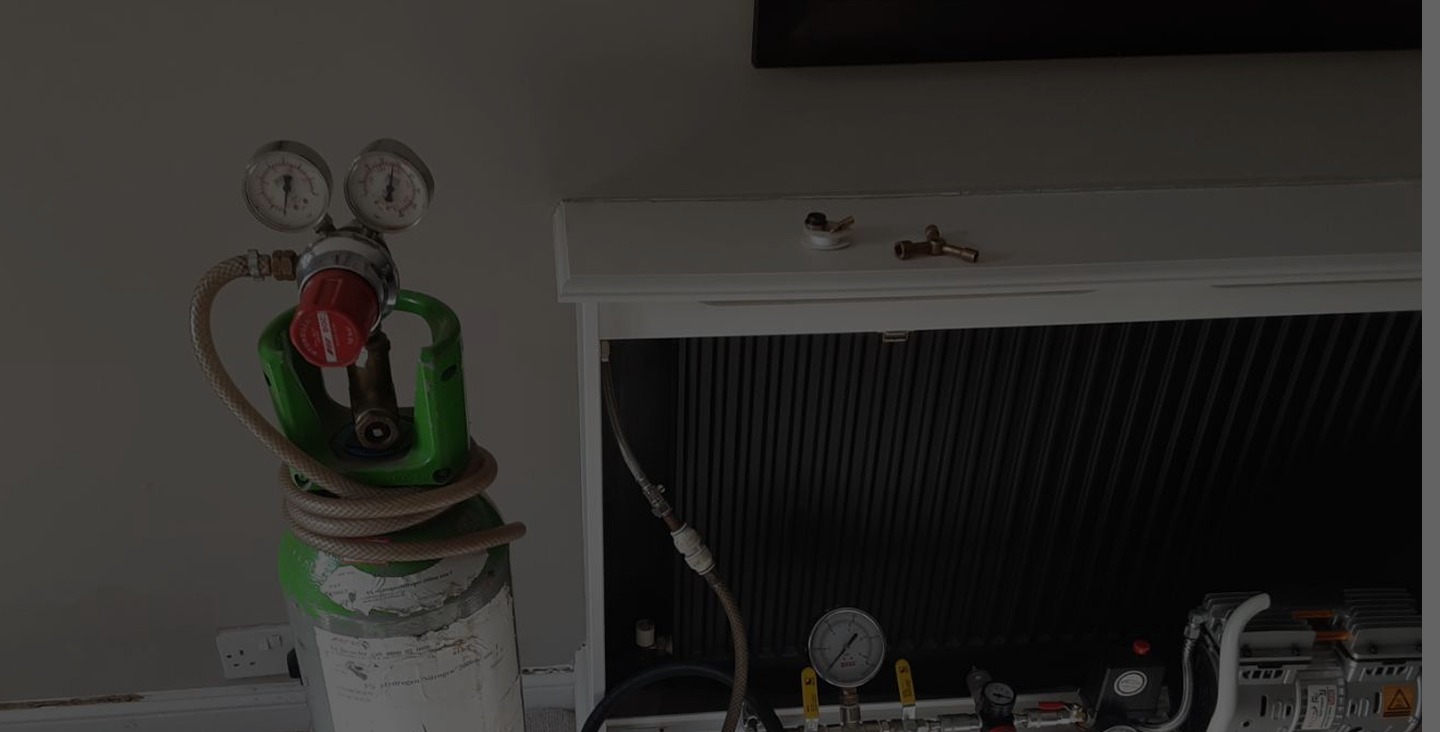
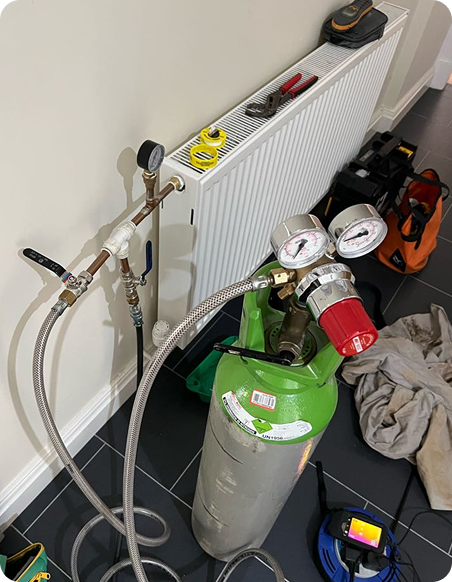
  • Tracer gases are a non-invasive way to detect a leak in a central heating system. Firstly the heating system is drained and a completely safe non toxic mix of gases is filled into the pipework, then a highly sensitive probe is run along the pipework that runs throughout the property, as the gas is released through many cracks it alerts the probe and the location of the leak is found. As the gas rises from the damaged pipework its particles are small enough to travel up through wood, carpet, tiles and even concrete! This means we are able to use this method to locate the leak without having to cause any mess or damage to your home.
Tracer gas detector

Thermal Imaging

  • Thermal imaging is a powerful technique we use to find central heating leaks. Using a high tech camera that shows the thermal energy that the pipes let off we are able to use this technology to detect where the central heating pipes are hiding under floors and inside wall cavities and see where the leak is coming from. As water leaks cause discrete temperature variations the thermal imaging camera picks up the abnormal temperatures the images produce. This is also an important tool used alongside other leak detection techniques so our engineers know exactly where hidden pipes are around your home so they know where to search.
Acoustic leak detector

ACOUSTIC LEAK DETECTORS

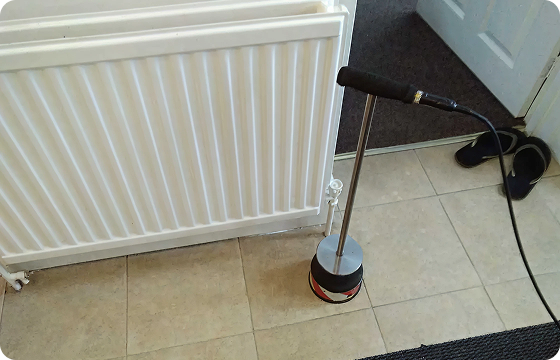
  • An acoustic microphone is a highly sensitive device that detects the noise of a leak escaping from a pipe, as every water leak, be it big or small, creates noise. Our acoustic listening devices are able to pick up and amplify these noises for our engineers to detect. We are then able to correlate the exact location of the leak by using two listening devices at the same time to triangulate where the sound is coming from by calculating how far away the noise is from each microphone. This technique is especially useful for pipes that are buried deep under floors or inside an insulated wall.
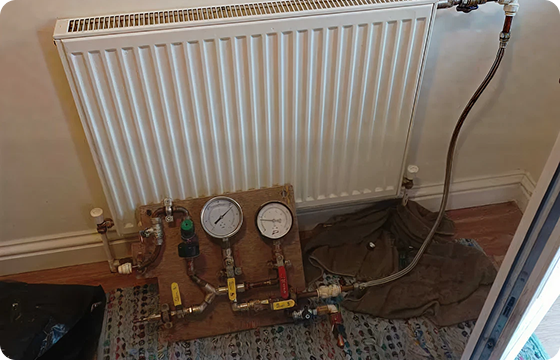
Pressure testing equipment

Moisture Meters

  • Moisture metres check the levels of moisture on surfaces. Our engineer will take several readings around your home where central heating pipes run around your property and around the boiler itself to check for areas with higher levels of moisture to pinpoint the source of the water leak. Higher levels of moisture present indicate there may be a central heating leak nearby. Sometimes as some materials are harder to test then others we may need to drill a small hole to take more accurate readings inside the surface. Although this approach isn't completely non-invasive, the damage caused is very minimal with this method.
Borescope inspection camera

Borescope Cameras

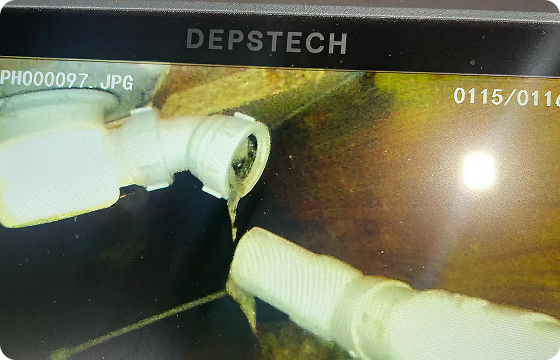
  • Borescopes are specialised inspection cameras that have a flexible tube with a light source and camera on the end which transmit high definition images and videos that can be viewed in real time by the operator. They are specially designed to inspect hard to reach areas like inside walls, floors and other confined spaces to search for signs of water leaks. This method requires a small hole to be drilled into the area that needs inspection behind it if no other access point is available, but as the borescope is no larger than 6mm in diameter the drilled hole is very small and can be repaired easily leaving no evidence of it ever being there.

READ REVIEWS OF OUR LEAK DETECTION SPECIALISTS

OUR ACCREDITATIONS

Banbury Heating Leak Detection FAQ'S

Got questions? We've got answers! If you don't find what you're looking for, feel free to reach out to us.

Contact Us
Can’t I just find out how to add leak sealer to my central heating system?

There’s a range of Central Heating leak sealants that claim to offer a quick solution to finding and fixing a leak in a pressurised system – but be warned; they’re never as effective as physically dealing with the problem.

The issue is, leak seal is not an exact science. It may partially fix the leak – but it also might attach to rust and corrosion to cause further problems. There are instances where sealant has led to bigger issues needing repairs elsewhere in the system.

Don’t be tempted by a sticky-plaster approach to a problem that can cause serious damage to your property.

How much does a home central heating leak detection service cost?

There’s no fixed rate for leak detection, instead; the price depends on the type of property we’re coming to. As you can no doubt imagine; it’s usually simpler to locate a leak in a domestic property than it is in a large commercial building.

The good news is, it’s highly likely that your building insurance policy will cover all of the cost involved with your central heating system leaks.

Virtually all building insurance policies cover ‘Trace and Access’ for central heating leaks – so any charge will usually be refunded to you. What’s more, we have partners who are on hand to help you deal with any related insurance claim – so you don’t need to worry about the paperwork or phone calls involved.

We know better than anyone that being in a home with a leak, no heating, and no hot water is stressful enough; so we’ll make sure you’re helped with every step – we’ll even ensure you’ve got all the reports you need to support your insurance claim.

Team receiving awards

WHAT’S THE NEXT STEP?

If you think there’s a leak in your central heating system, acting fast is the key to keeping your costs down.

Get in touch with us now. You’ll speak to a friendly and knowledgeable member of the team who’ll help you deal with your central heating leak today.

CALL NOW ON 0800 731 3843